sreda, 8. april 2015

CASTLE KRUPA (KRUPP)

Historical region Carniola
Author: Hugo Gerard Ströhl 1890
Municipality: Semič

LOCATION
Country: Slovenia
Historical region: Lower Carniola
Municipality: Semič
Settlement: Stranska vas pri Semiču
GPS:45°37'53,91" N 15°13'32,55" E

Castle Krupa from the book,
Die Ehre dess Hertzogthums Crain in 1689
Author:  Johann Weichard Valvasor


NAME:
Name Krupa is derived from the nearby river Krupa.

HISTORY:
First written mention of the castle is from the year 1427 as castrum Cruppa. It was probably built in the 13th century but all medieval records are lost. In 1565 castle Krupa was attacked and looted by the Turks. In 1942 castle was set on fire and it burned for two weeks. Later locals used castle ruins for qarrying stones for building new houses.

PICTURES:
Castle Krupa in 1893, author: Jos. Germ.
Ruins of the castle

OWNERS:
Before the year 1374 and to the year1418 it was owned by Counts Ortenburg
1418 - 1456 Counts Cilli     
at the end of 15th century Andrej pl. Hohenwart       
1483 -1704 Counts Purgstal
1704 Johann Michael Androk
1710 Count Franc Adam Lamberg   
1723 Count Karl Henrik Wazenberg   
1723 -1735 Count Franc Bernard Lamberg
Approximate from1735 - 1772 Peter Paul pl. Bonazzi
1773 -1796 baroness Apfaltrer-Bonazzi   
1796 -1904 baron family Apfaltrer       
1904 -1912 Danijel Makar and Julij Macele   
1914 -1918 Land bank in Prague       
1918 Josip Zurc    


MAPS:
Military map of Castle Krupa (1763-1787)
Source: http://mapire.eu/en/
Franciscan cadastre of Carniola (1823-1869)

MANSION DOMINECE (DOMINITSCHOFF)

Historical region Carniola
Author: Hugo Gerard Ströhl 1890
Municipality: Metlika
Author:  Johann Weichard Valvasor

 LOCATION
Country: Slovenia
Historical region: Lower Carniola
Municipality: Metlika
Settlement: Mlake
GPS:45°36'4,04" N 15°15'40,93" E
Mansion Krasinec from the book,
Die Ehre dess Hertzogthums Crain in 1689
Author:  Johann Weichard Valvasor
HISTORY:
Manson Dominece was built by Peter Dominič who owned the estate in 1563 and named it after itself. In the late 17th century the owners were noble family of Gusič. In 1888 the owner was Henrik Grünwald and in 1896 Emanuel Kühnel.

torek, 7. april 2015

MANSION KRASINEC (CRASSINZ)

 
Municipality: Metlika
Author:  Johann Weichard Valvasor

Historical region Carniola
Author: Hugo Gerard Ströhl 1890
LOCATION
Country: Slovenia
Historical region: Lower Carniola
Municipality: Metlika
Settlement: Krasinec
GPS:unknown
Mansion Krasinec from the book,
Die Ehre dess Hertzogthums Crain in 1689
Author:  Johann Weichard Valvasor
NAME:
The name Krasinec means splendid.

HISTORY:
According to written account of historian Johann Weichard Valvasor, the mansion  Krasinec was built in the year 1686. The mansion was built on the site of a previous castle estate which has already been burned down twice by Vlachs. On the location of the mansion was a big pigeon house. Due to the exposure of incursion army predatory attacks the mansion was abandoned and destroyed. From the late 18th century mansion is no longer mentioned.
  
OWNERS: 
The only known owner of the mansion Krasinec was its builder Johann Adam nobleman Purgstall. In the year 1715 is mentioned Jurij Sigfrid Purgstall who died in the mansion but was not its owner.


Castle owners B/Purgstall
SOURCE:
http://sl.wikipedia.org/wiki/Dvorec_Krasinec 
http://www.slosi.info/01gradovi/02podrobnejse/dolenjska/k-1/krasinec.php

sreda, 1. april 2015

CASTLE GRADAC (GRADEZ)

Historical region Carniola
Author: Hugo Gerard Ströhl 1890
Municipality: Metlika
Author:  Johann Weichard Valvasor


LOCATION
Country: Slovenia
Historical region: Lower Carniola
Municipality: Metlika
Settlement: Gradac
GPS:45°36'48,61" N 15°14'46,55" E


Castle Gradac from the book,
Die Ehre dess Hertzogthums Crain in 1689
Author:  Johann Weichard Valvasor


NAME:
Name Gradac shows to the previous late ancient fortyfied settlement on the location of the castle and the name was later transfered to the castle.

HISTORY:
First indirect written mention of the castle is from the year 1393 as Grecz schloß. It was supposed to be build just before the year 1300 by Mainhard Auersperg.

COAT OF ARMS: 
Coat of arms of noble family Gussich and previous owners of the castle,
 on the door in front of the castle

OWNERS:
Castle owners from left to wright: Auersperg, B/Purgstall, Gusitch


PICTURES:


MAPS:
Military map of Castle Gradec (1763-1787)
Source: http://mapire.eu/en/

 
Franciscan cadastre of Carniola (1823-1869)

petek, 27. marec 2015

CASTLE AND CITY METLIKA (MÖTTLING)

Municipality: Metlika
Author:  Johann Weichard Valvasor
Historical region Carniola
Author: Hugo Gerard Ströhl 1890

LOCATION
Country: Slovenia

Historical region: Lower Carniola
Municipality: Metlika
City: Metlika
GPS:45°39'5,6" N 15°19'3,37" E


Castle and city Metlika from the book,
Die Ehre dess Hertzogthums Crain in 1689
Author:  Johann Weichard Valvasor
NAME:
The origin of the name Metlika has supposed to came from fugitive people of Japods from their former capital city Metulum, which was conquered by the Romans with twelve legions in 33 BC. Survivors of the newly established town named it Metlika in the memory of the lost city.

HISTORY: 
First written mention of the castle Metlika is from the year 1338 as Möttling. In the year 1431 castle and city Metlika were conquered by  8.000 headed army of the Turks. City was then still largely built of wood and Turks managed to kill most of the population and the rest were taken as prisoners of war to be sold as slaves, the church was torn down and valuables stolen. The settlement was fortified in to a city in the 15th century because of the Turkish threats. Castle was in the begining and at the end of 18th century burned down but later rebuild.

COAT OF ARMS: 
On a white shield is a depiction of a red tower with two raven guards. White is a metal colour that represents purity, cleanliness, innocence, wisdom and joy. The tower represents safety and grandeur, color read represents right, strength, courage, dignity and love. The black ravens represents divine providence and colour black perseverance, humility, peace, death, ruin and sadness.
Coat of arms of the city Metlika
Author:  Johann Weichard Valvasor
LEGEND:  
In old days Metlika was just a village. One of the lord commanded the settlers to built castle Pungart next to the village, which was guarded by castle guards. In the castle lived an evil countess. She took from farmers their grain, wine and livestock. Anyone who resisted was sent to prison where they were thrown to the bottom of the castle tower, left to die.The Countess cursed whenever she got angry. When she did, then everyone froze with terror and fear. Whomever she cursed was turned into stone.One day the Turks started attacking close to Metlika. The Countess orderd her guards to wake up all the servants if they got closer to the castle. One night the guards fell asleep and Turks climbed the walls and broke into to the castle. Countess realized that the Turks had come. She was angry and miserable cursed the two guards. Her curse has turned them into a black ravens, which flew on the roof of the castle tower. The Turks killed the evil Countess and burned down the castle. Only castle tower remained, which the fire has not touched. The Turks have repeatedly attacked Metlika but settlers have heroically fought against them and therefore got city rights and Metlika became a city.Over time, the castle tower collapsed into dust and of castle Pungart was left no trace. With the help of this story was created city coat of arms, which represents the castle tower and the two seated enchanted guards turned into ravens.

OWNERS:
In the 16th century the owners were Counts Allaps, next were croatian nobleman Frankopans. In the 18th century the ownership of the castle was under Zagreb Cathedral Chapter, after fire in 1790 the owner become innkeeper Jozef Savinsek. In 1899, Savinsek sold Castle Metlika to People's Loan Bank of Ljubljana.

PICTURES:
Source: http://www.kamra.si/Default.aspx?module=7&id=3654
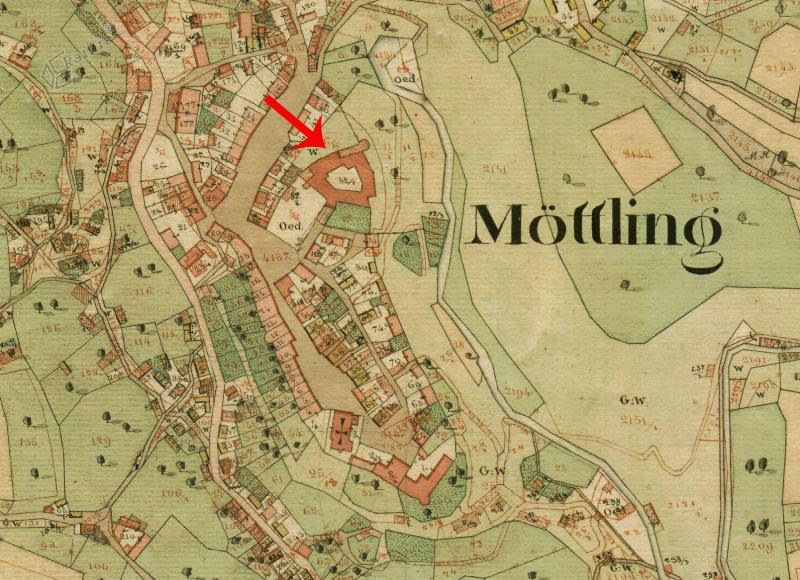
MAPS: 
Military map of Castle and market Weinitz (1763-1787)
Source: http://mapire.eu/en/
Franciscan cadastre of Carniola (1823-1869)
SOURCE:
http://www.kamra.si/Default.aspx?module=5&id=514


četrtek, 26. marec 2015

CASTLE POBREZJE (FREYTHURN)

Historical region Carniola
Author: Hugo Gerard Ströhl 1890
Municipality: Crnomelj
 Author:  Johann Weichard Valvasor


LOCATION
Country: Slovenia

Historical region: Lower Carniola
Municipality: Crnomelj
Settlement: Pobrezje
GPS:45°31'52,07" N 15°18'42,96" E


Castle Freythurn from the book,
Die Ehre dess Hertzogthums Crain in 1689
Author:  Johann Weichard Valvasor
HISTORY:
Freyturn Castle was built as a fortress against the Turkish invasions at the site of one of the most common route of incursions in Low Carniola. Castle was build in the year 1557 by baron Ivan Lenkauitsch after aaproval of the Austrian Emperor Ferdinand I.  Despite repeated Turkish siege of the castle it has remained unconquered, and hence the name of Freedom tower. Within the castle walls was the market.
In 1575 from castle Freythurn started huge invasion of combined Carniola, Styria and Carinthia regions with their best knights Herbard Auersperg and Frederick Weichelstein and rode into battle against a larger Turkish army.  They were defeated by the Turks in Budacka. Herbard and Friderik were captured and their heads were chopped off and taken in Istanbul for display. 

Herbard Auersperg
1528 - 1575
During World War II castle was twice burnt down and plundered. Local used ruins as a stone quarry for building new houses. Church of St. Florian build in 1697 by Adam Count Burgstall is also in ruines. Last mass inside the church was in the year 1859.


PICTURES:
Author: Germ, Josip
Year: 1893
Castle Freyturn in 1938 (before destruction)
Author: Bozo Racic


Ruines of castle Freyturn in 2010
RECONSTRUCTION:
in progres...


OWNERS: 
Coat of arms of the founder of the castle Freyturn, lower Carniola Commander, Deputy Commander in Bihac, Zumberak governor, captain of Senj incursion army and General of region Military Frontier, Croatian Baron Ivan Lenkauitsch "Lenkovič".
Castle owner Lenkauitsch
from the book Opus insignium armorumque 1687-1688

In 1564 the castle was bought by Christopher nobleman Burgstall from castle Crupa. Castle was Inherited by his son Adam Burgstall. Subsequent masters were baron George Lenkauitsch in 1599,  Burgstall 1614, Count Andrej Danijel Barbo, Joseph Leopold Bonazzi 1752, Countess Francis Auersperg 1773, Alojz Apfalter 1797, Catherine Gall, Janez Christopher, Janez Balazar, Jernej and Michael Monfrienoma. In 1904 Danijel Makar and July Mazelle. In 1914 it came into the ownership of the Land Bank in Prague, next Anton Urca and dynasty Rauch.
Castle owners from left to wrigh: Lenkauitsch, Burgstall, Barbo, Auersperg
from the book Opus insignium armorumque 1687-1688
MAPS: 
Military map of settlement and castle Freythurn (1763-1787)
Source: http://mapire.eu/en/
Franciscan cadastre of Carniola (1823-1869)

sreda, 25. marec 2015

CASTLE PUSTI GRADEC (ÖDENGRADEC)

Municipality: Crnomelj
 Author:  Johann Weichard Valvasor
Historical region Carniola
Author: Hugo Gerard Ströhl 1890

LOCATION
Country: Slovenia
Historical region: Lower Carniola

Municipality: Crnomelj
Settlement: Pusti gradac
GPS:45°31'5,74" N 15°11'55,56" E


Castle Pusti Gradec from the book,
Die Ehre dess Hertzogthums Crain in 1689
Author:  Johann Weichard Valvasor
HISTORY:
Location on which castle was build was once a prehistoric fortified settlement. The first direct mention of the castle is from 1597, when the first known owner Gasper Krizanic is mentioned. No other previous medieval record is known. Indirectly, it is mentioned in 1615, when a soldier Henrik Plasmann was the owner of the mansion. Henrik was massacred by the Turks in Podlog when he was returning to his wife Elizabeth Gall. A ballad was written for this event by a poet Ritter von Kalchberg. Older son Franc Plasmann was sentenced to death for the murder of his stepfather, but he escaped from prison and hide in Croatia. Croatian Count Frankopan made him a manager of his estates, but was soon imprisoned because of damage he has done to the estete. He spend the rest of his life in prison. Last of the noble family, Matej Plasmann was a captain of a horse Croatian Company. He was also killed by the Turks when returning home, and so family of Plasmann went extinct. Castle was abandoned in the 19th century and by the year 1916 was already in ruines.

BALAD:
Auf seiner Burg in Krainerland
Nach schweren Türckenkriegen
Saß Heinz von Plasmann, weit bekannt
Ob seinem Muth und Siegen;
Denn mancher brave Ritter sank
Durch seinen Speer beim Rennen
Odft seine durst` ge Klinge trank
Das Blut der Sarazenen...

Author:  Ritter von Kalchberg, published in Laibacher Wochenblatt 1818.

OWNERS: 
 Captain Gasper Krizanic in the year 1597, Henrik Plasmann in 1615, in the first 17th century Countess Barbara Kacijanar, Matej Plasmann from the year 1635 baron Karel Vajkard Burgstall, Janez Mihael Androka, Count Franc Bernard Lamberg in 1722, Peter Pavel Bonazzi from 1735 to 1772, baron Apfaltrer to the year 1904.
Castle owners Burgstall
from the book Opus insignium armorumque 1687-1688
LEGEND:
Turkish invasion
According to legend, Castle Pusti Gradec was invaded and conquered by the Turks. Lordships have fled through a secret passage to a more fortified castle Brdarci, which locals named "Castle Meta". During  retreat from the castle Pusti Gradec nobleman were shouting "leave the castle!" and hence the name of Pusti Gradec which means Leave the Castle.

Church of all Saints
In the church by the castle Pusti Gradec villagers hung a new bell. According to the old custom, they were not allowed to ring it before the bell was baptized. One of the villagers was impatient and could not wait until the priest blessed the bell. In the middle of the night he sneaked to the church and pull the rope of the bell and the ringing echoed around the area. Then come to the church the devil himself, and said, What is not baptized shall be mine! He took the bell deep into deep river Nerajcica. When the next morning, people find out where the bell is, they have decided to be pulled it out of the river. However, under the direction of Pastor in this work was not allowed to speak to anyone until the bell will not be in the church. Bell had had on the rope and they pulled strongly. Since it hardly moved toward the surface, one of the villagers shouted: God help us! As he spoke, the rope teard and the bell sank deeper into river. The bell was never seen again, and in the church under the bell tower it is said you can still see the imprint of the Devil's hoof.
Church of all Saints in Pusti Gradec
MAPS: 
Military map of settlement and castle Pusti Gradec (1763-1787)
Source: http://mapire.eu/en/
Franciscan cadastre of Carniola (1823-1869)
SOURCE:
https://sl.wikipedia.org/wiki/Dvorec_Pusti_Gradec
http://www.slosi.info/01gradovi/02podrobnejse/dolenjska/p-1/pusti-gradac.php
http://www.kamra.si/Default.aspx?module=5&id=134